Insurance products
Monsure is the configuration layer your core was missing. Describe a product once. Monsure ships the REST APIs, OpenAPI spec, TypeScript SDK, customer buy-flow, chat copilot, embeddable widget, and MCP server for AI agents. All from the same definition. It plugs into your existing core through six adapter shapes, so your AS/400 stays where it is and your customer master is never duplicated.
Configure once. Everything elsefollows automatically.
Configure
A versioned, immutable Product DSL describes everything: lifecycle, coverages, sum-insured ranges, parametric triggers, eligibility, compliance metadata. Edit it in JSON or by talking to the AI. Drafts diff against published — preview-impact replays the last 30 quotes through your changes before you ship.
- AI authoring: NL → product DSL
- Editor copilot: NL → patch, applied with diff
- Versioned & immutable; in-force policies pin their version
Generate
Publishing a product spawns ten REST endpoints, an OpenAPI 3.1 document, a TypeScript SDK, and a polished docs bundle (README, Postman collection, request/response samples, PDF reference). Hand it to your tech team. Integration starts the same afternoon.
- 10 endpoints/product (quote, accept, bind, claim, aggregation, …)
- Auto-generated OpenAPI 3.1 spec + TypeScript SDK
- Downloadable docs bundle: README, Postman, PDF, samples
- Tenant-scoped API keys with per-route scopes
Distribute
The same configured product drives a modern customer buy-flow, a per-tenant configurable chat copilot, a drop-in iframe widget for partners, and an MCP server that lets Claude (or any agent) quote, bind, and claim natively. Configure once, sell on every surface.
- Web + mobile customer flow (fintech-grade)
- AI chat copilots, scoped to product allowlist
- Embeddable iframe widgets w/ postMessage
- MCP server for agentic clients
One source of truth. Every interface kept in sync.
Edit the product spec — your APIs, OpenAPI, SDK, customer buy-flow, chat copilot, partner widget, and agent surface all update together. The carrier never has to remember to ship the change to four places.
Talk to your platform like you'd talk to your product team.
AI Authoring: describe a new product in plain English — Monsure drafts the entire Product DSL, with coverages, eligibility, rate references, and compliance metadata, and hands it to you as an editable draft. Editor copilot: on any published product, propose changes by typing — "raise Fire to $200k, add a Cyber Response rider" — and see the diff before you save.
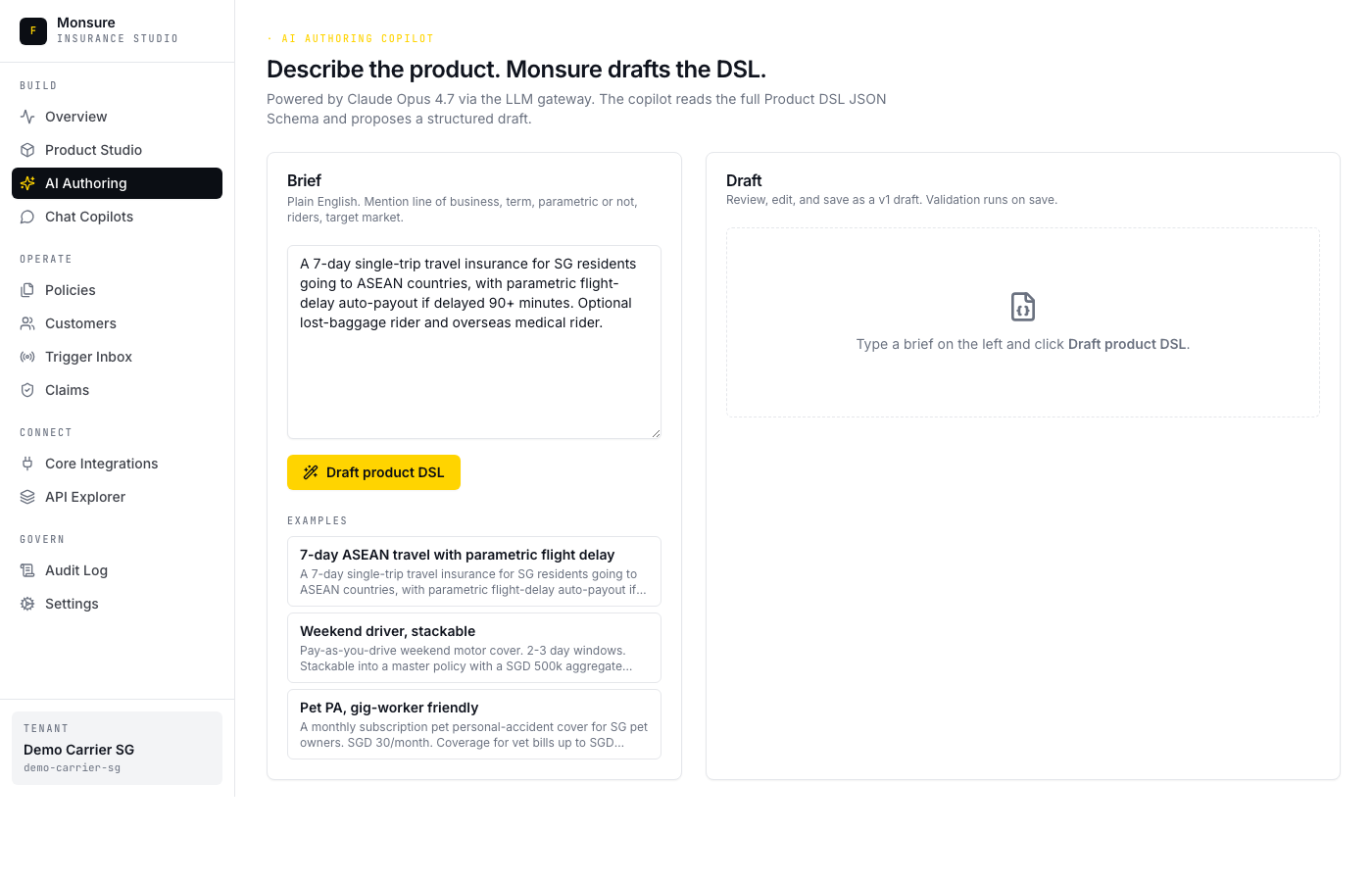
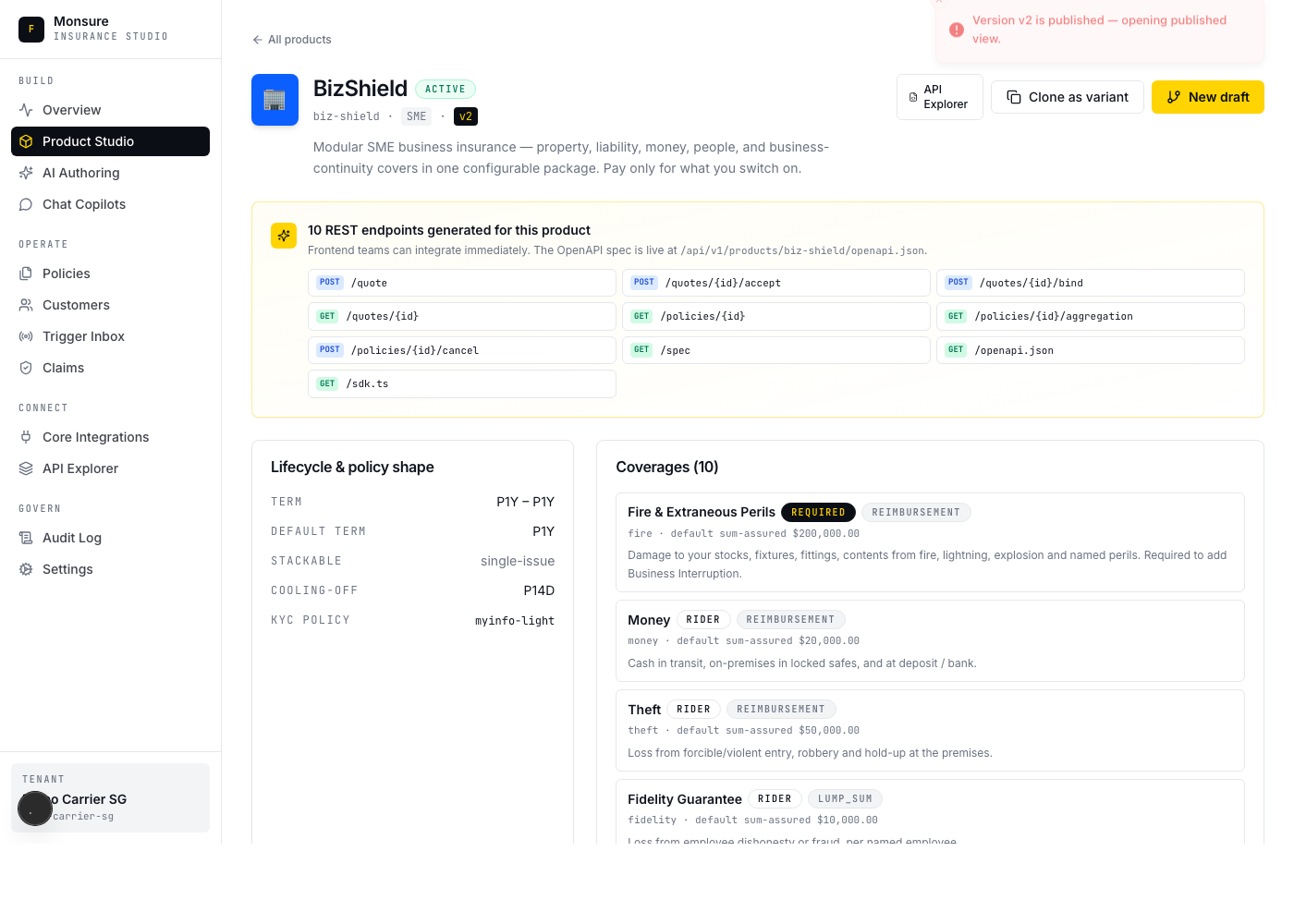
In-force policies stay on their bound version forever. Edits create new versions; old policies don't change.
Replay the last 30 priced quotes through your draft. Premium-delta histogram before you ship.
Every save runs full Zod schema + linter. Compliance fields (MAS, AI-Act risk) are first-class.
Publish a product.Ten endpoints ship instantly.
The dynamic router reads your published spec and serves quote, accept, bind, get-policy, aggregation, cancel, OpenAPI, SDK, and DSL endpoints — under a versioned namespace per product. No manual route registration. No integration team waiting to write connectors.
- POST/api/v1/products/{code}/quote
- POST/api/v1/products/{code}/quotes/{id}/accept
- POST/api/v1/products/{code}/quotes/{id}/bind
- GET/api/v1/products/{code}/policies/{id}/aggregation
- GET/api/v1/products/{code}/openapi.json
- GET/api/v1/products/{code}/sdk.ts
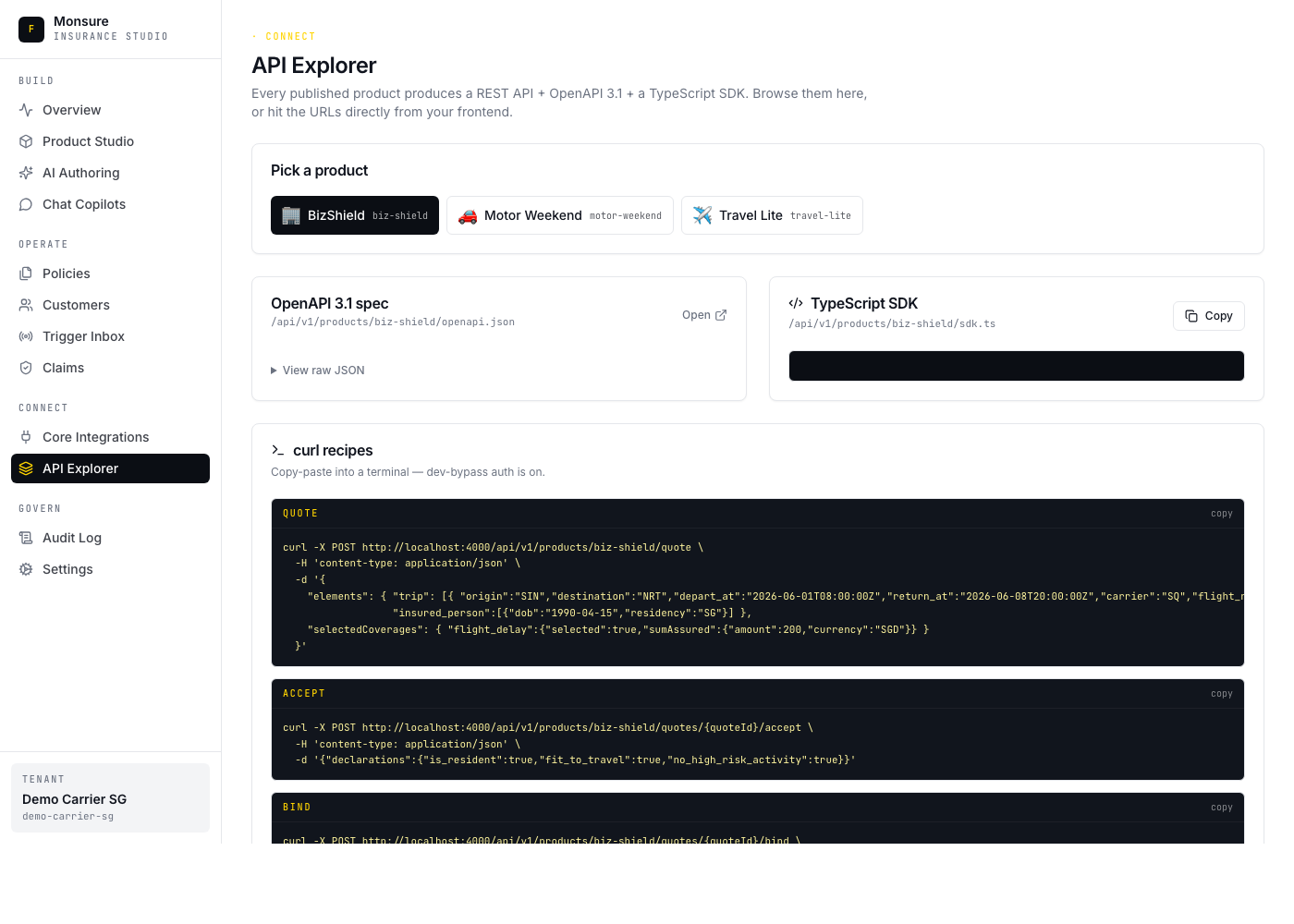
Same product. Four surfaces. Pick any. Or all.
The buyer chooses the channel. Monsure makes sure every channel sees the same up-to-date product, with the same rating, the same UW rules, the same disclosures.
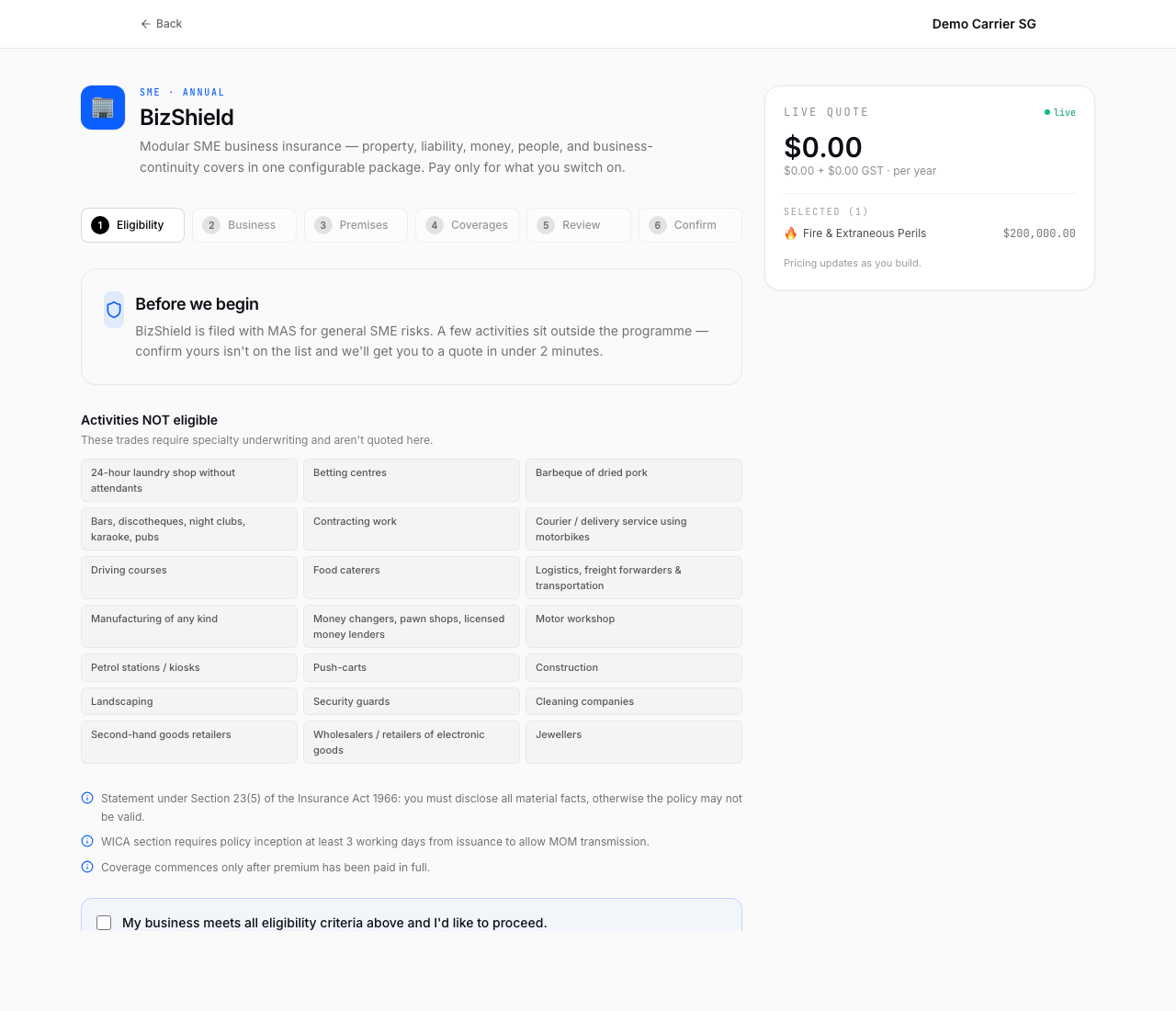
Modern customer buy-flow
Six-step wizard with a sticky live-quote rail. Presets, sliders, conditional sub-fields. Fintech-grade UX — not the eleven-step single-column form your last carrier portal shipped.
Configurable chat copilots
Carrier authors a copilot in plain English. Persona, scope (which products), greeting, disclaimers — drafted by AI in under a minute, published in two clicks. Customer types instead of clicking.
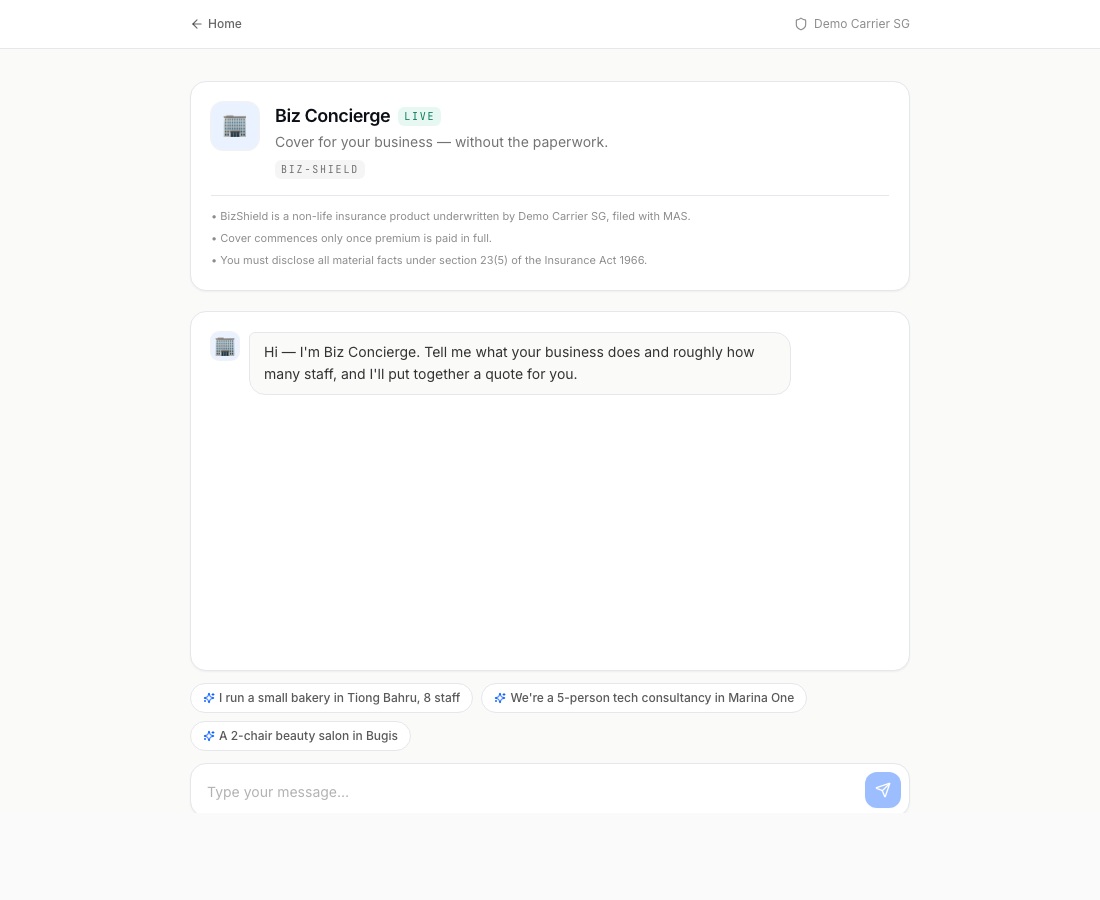
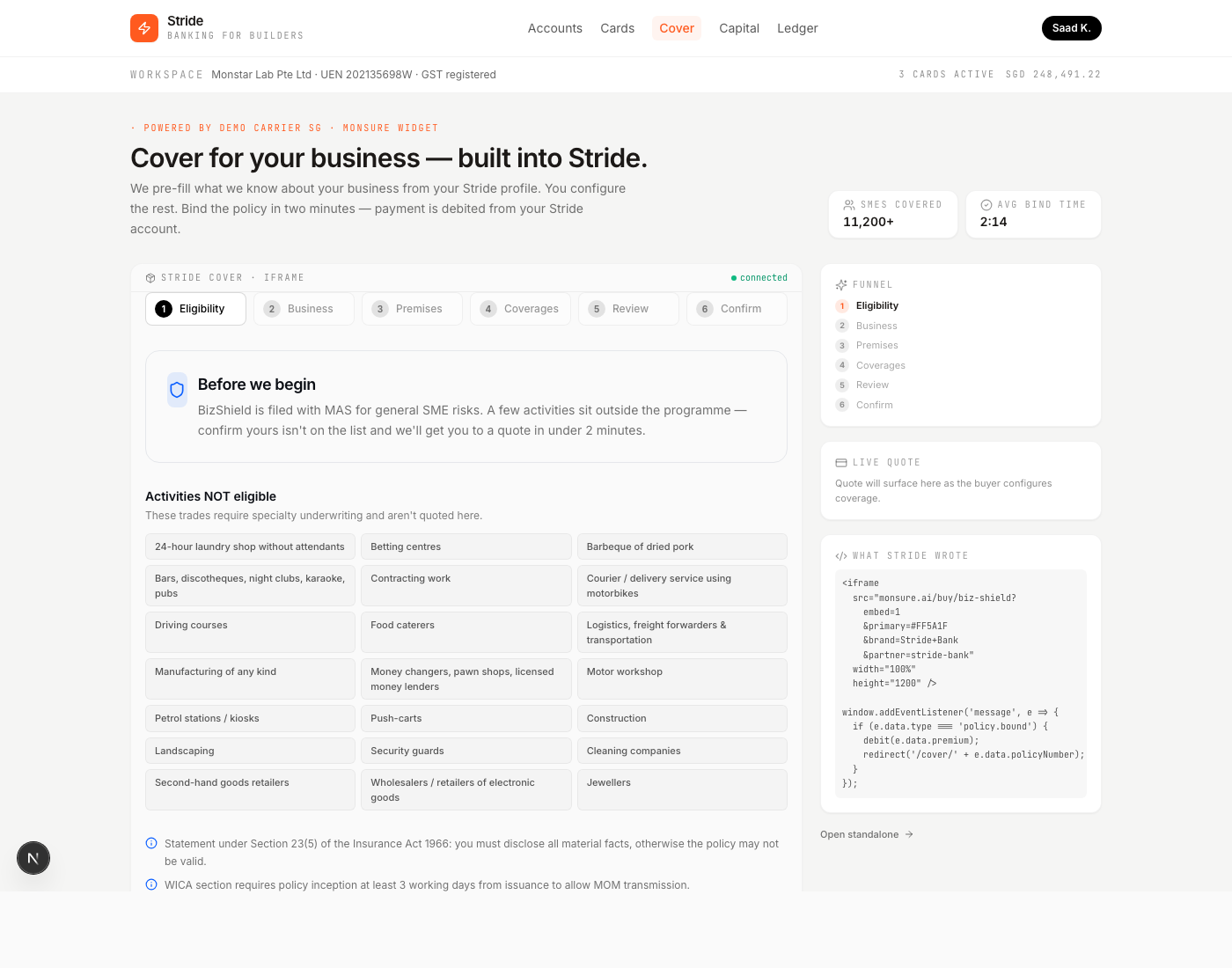
Embeddable partner widget
Eight lines of HTML, postMessage events, theme via URL params. A bank, broker, or aggregator embeds your product in their dashboard. You stay carrier-of-record; they keep the user relationship.
Native agent surface (MCP)
Drop our MCP server into Claude Desktop's config — Claude can list products, quote, bind, claim, fire triggers, read OpenAPI. The same backend that powers your apps now speaks the agentic web.
> claude

claude › use forge mcp to quote a 7-day Tokyo trip
        for a 35-year-old from Singapore, and bind
        if the price is under S$30.

  ⏺ list_products → travel-lite, motor-weekend,
                    biz-shield
  ⏺ get_product_spec(travel-lite) → DSL …
  ⏺ create_quote → S$24.75 · UW: accept
  ⏺ accept_quote, bind_quote
⇒ Policy TR-2026-00FN1J · in force.Six AI surfaces in one platform.
Other middleware vendors are duct-taping ChatGPT onto policy admin systems built in 1998. Monsure was designed around AI from day one — every step from authoring to claims has an AI surface, with cost attribution, tenant-scoped guardrails, and full audit. One LLM gateway, one cost ledger, one policy.
AI Authoring
Plain-English description → full Product DSL drafted, schema-validated, ready to refine. Surface used during product ideation.
Editor copilot
On any draft version, type a change request. The model proposes a new spec; you see the diff and apply with one click.
Chat copilots
Carrier-authored chat assistants per product line. Drafted from a paragraph, scoped to an allowlist, published with brand + persona.
Buy-flow LLM extract
Buyer types one sentence about their business; the form pre-fills industry, headcount, wages, premises hints, suggested coverages.
MCP agent surface
Claude Desktop and any MCP-aware client can natively quote, bind, claim, and fire triggers. The carrier's existing API now speaks the agentic web.
Compliance redliner
MAS / PDPA / AI-Act review of customer copy, with severity grading. Plugged into the same audited LLM gateway with cost attribution.
{
  "mcpServers": {
    "monsure": {
      "command": "npx",
      "args": ["-y", "@monsure/mcp"],
      "env": {
        "MONSURE_TENANT_SLUG": "demo-carrier-sg"
      }
    }
  }
}
Ten tools exposed: list_products, create_quote, accept_quote, bind_quote, fire_trigger, get_openapi — the entire platform, addressable by an agent.
Claims paid before the customer calls.
Wire any data source — flight feeds, Visa MCC merchant data, weather, telematics — to a coverage. When the predicate fires, Monsure auto-pays the policy, books the claim, syncs the carrier core via the outbox. Customer's phone vibrates with their pay-out before they think to file a claim.
- Flight delay ≥ 2h→ travel-lite auto-payvia AviationStack
- Merchant outage ≥ 60min→ biz-shield BI dayvia Visa MCC
- Wind speed ≥ 80km/h→ home-cyclone payoutvia OpenWeather
- Card-MCC dining spike→ activates dining covervia Card networks
- 1Visa flags merchant offline 95minsigned event
- 2Mapping matches by UEN ↔ business.uenpath-resolved
- 3Auto-claim CLM-2026-… createdpaid · S$500
- 4Outbox · claim.paid → carrier coreidempotent
- 5Customer notifiedreal-time
Plugs into your AS/400. Without inheriting it.
Carriers don't throw away the policy admin system that runs the business. Monsure connects through six pluggable adapter shapes — REST, SOAP, DB2/AS-400, IBM MQ, SFTP/EBCDIC, CDC — and a Mock for demo. An outbox + reconciliation pattern guarantees the core stays in sync without tight coupling.
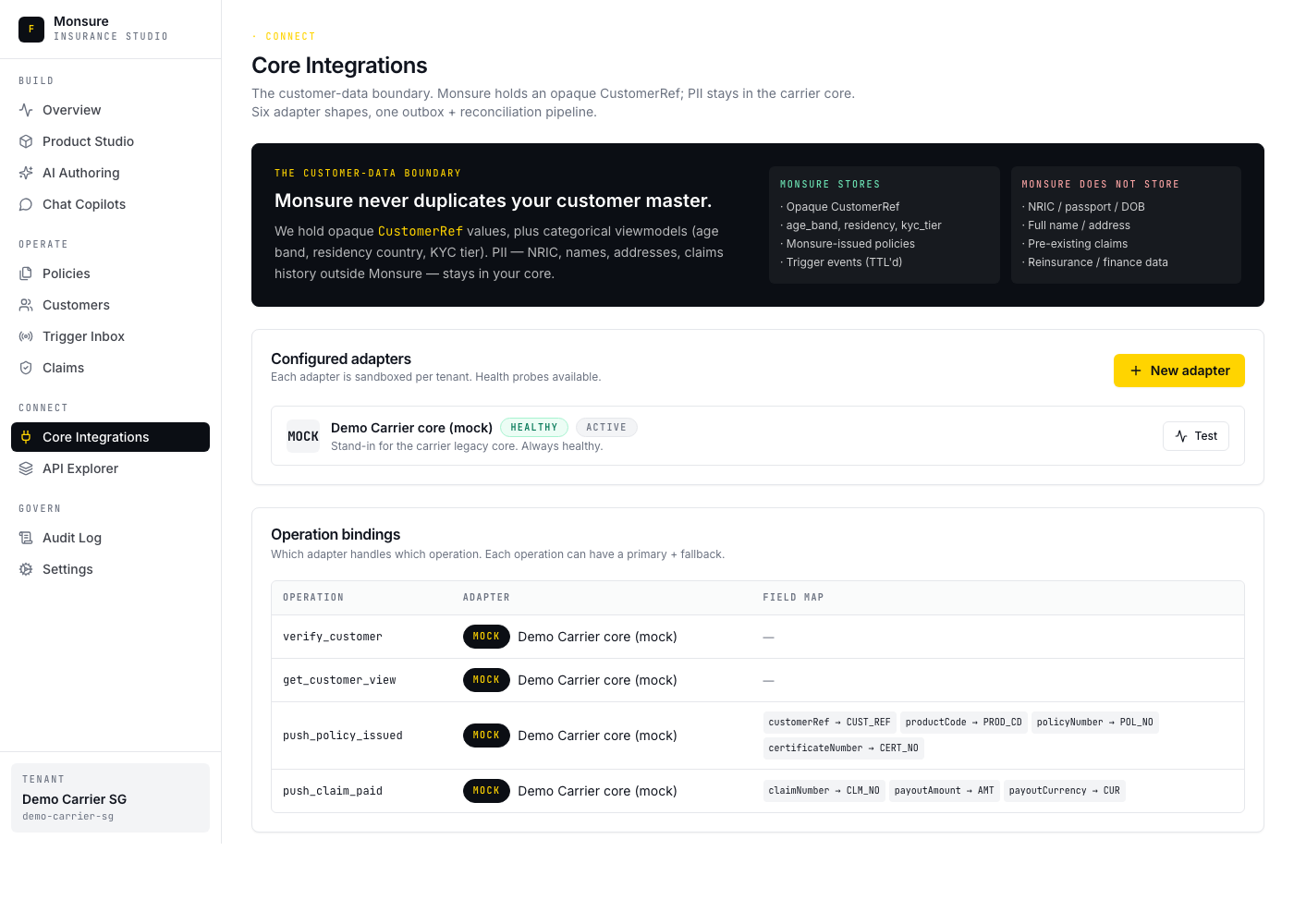
Monsure never duplicates your customer master.
We hold an opaque CustomerRef + categorical viewmodels (age band, residency, KYC tier). NRIC, names, addresses, claims history outside Monsure — stays in your core.
- · Opaque CustomerRef
- · age_band, residency, kyc_tier
- · Monsure-issued policies
- · NRIC / passport / DOB
- · Full name / address
- · Pre-existing claims
Six audiences. One platform.
From the product manager configuring a parametric BI rider, to the engineering team consuming the auto-generated SDK, to the agent ringing the API on the customer's behalf — each persona gets a surface that matches the way they want to work.
Carrier product teams
Configure, version, edit, and ship products without engineering tickets. AI authoring, draft + diff + impact preview before publish.
Engineering teams
Auto-generated REST + OpenAPI 3.1 + TypeScript SDK per product. Drop-in iframe widget. MCP server for AI agents.
Compliance & risk
MAS / PDPA / AI-Act-aware DSL fields. Immutable versioning. Per-tenant Postgres RLS. Full audit log of LLM calls with cost attribution.
Distribution & partnerships
Drop-in widget, theme via URL params, postMessage events. Stay carrier-of-record; partners keep the customer relationship.
Customers
Modern multi-step buy-flow with a sticky live-quote rail, a chat copilot if they prefer typing, or a partner widget on a site they already use.
Power users & agents
Claude Desktop. Internal AI agents. Partner bots. The MCP server exposes the platform natively — quote, bind, claim, all addressable.
Insurance middleware,designed in 2026.
Most middleware in the market traces back to architectures locked in a decade ago — composable core systems, integration buses, point-and-click product builders. They do their jobs. We made different choices because the world that surrounds them is different now.
| Dimension | Most middleware | Monsure |
|---|---|---|
| Time-to-first-product | 12–24 months | Days |
| New product → live API | Manual integration sprint | Auto-generated on publish |
| Customer surfaces | Forms only | Form · chat · widget · agent |
| AI surfaces | Add-on, retrofitted | Six native; one gateway, one ledger |
| Edit a product | Engineering ticket | Edit JSON · or talk to it |
| Multi-tenant isolation | Schema-per-tenant | Postgres RLS, one DB, FORCE |
| Customer PII | Duplicated in middleware | Stays in your core |
| Agentic clients (Claude, etc.) | Not addressable | Native via MCP |
Configure once.Sell on every surface.
30 minutes, with one of your hypothetical products configured live on the call. We'll show every surface — form, chat, widget, agent, parametric — in one demo.